

In this article I talk about the difference between ear infection and glue ear. This is important because while both conditions can cause hearing loss, we know when a child has an ear infection but do not necessarily know when a child has glue ear. Let’s look at both of them in turn
EAR INFECTION (Also called ‘Middle Ear Infection’ or ‘Acute Otitis Media’)
a. WHAT IS AN EAR INFECTION?
This picture shows the anatomy of the ear with a middle ear infection. You can see the middle ear is full of a thick sticky fluid much like ‘glue’ and the ear drum bulges with the fluid. In its normal state the middle ear is a clear space which secretes a fluid. This fluid drains away down the eustachian tube into the back of the nose or throat. However if this tube is blocked the middle ear fluid cannot escape. It builds up to fill the space. If the person has a cold, germs move up into the blocked eustachian tube and into the filled middle ear to result in a middle ear infection. It can be in one or both ears.
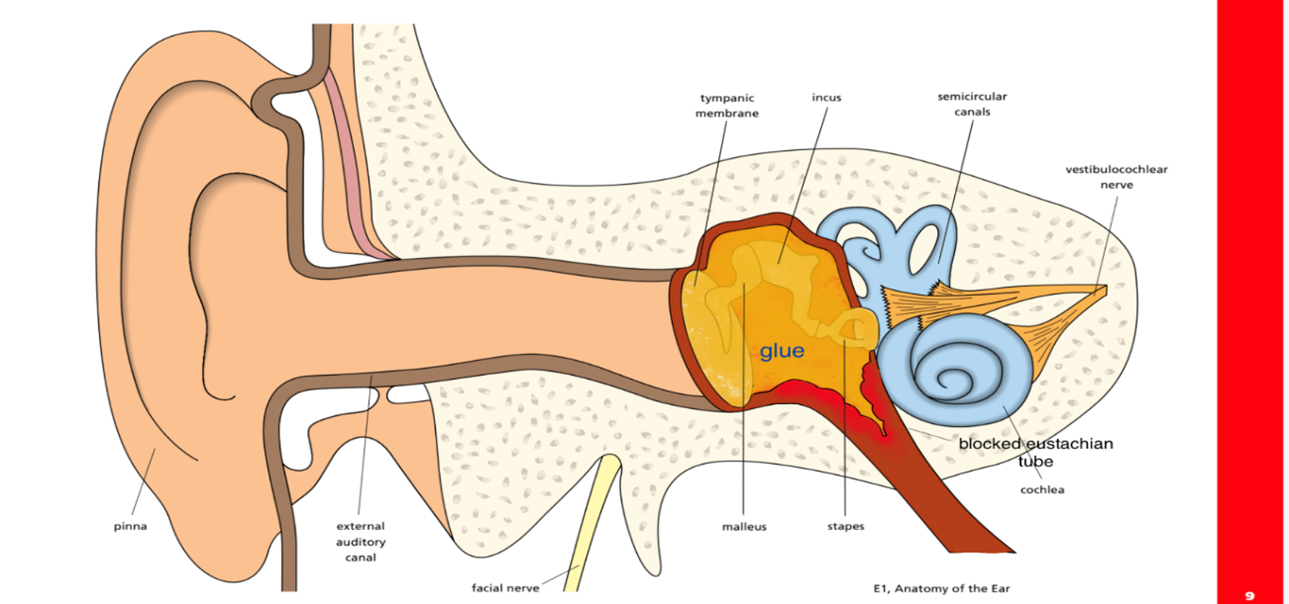
Babies and young children have smaller eustachian tubes, so middle ear fluid can be more difficult to drain.
b. SYMPTOMS
We know when a baby or toddler has an ear infection because they tend to:
- have a fever,
- be irritable,
- cry and scream due to pain.
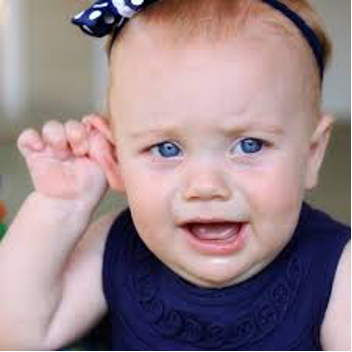
In this photo you can see the baby is touching or pulling his/her ears:
c. DIAGNOSIS and TREATMENT
Your GP will diagnose a ear infection by asking about the symptoms. He/she will then look inside your child’s ear using an otoscope to examine the ear canal and eardrum (also called ‘tympanic membrane’).Your doctor will straighten the ear canal by gently pulling the ear back and slightly up, for a clear view of the eardrum.
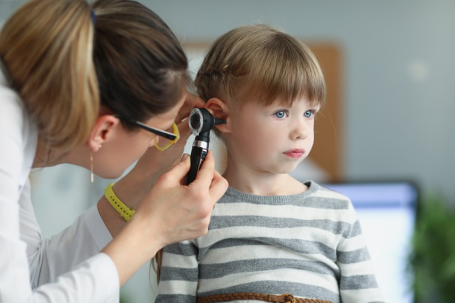
If your child has an ear infection, the ear drum will be red and bulging as it is in this picture.

It is usual for the GP to prescribe antibiotics to clear up the infection.
2. GLUE EAR
a. WHAT IS GLUE EAR?
The middle ear is filled with fluid, in one or both ears. It can be caused by:
- An allergy
- A cold or sinusitis
- Blocked nose
- Swollen tonsils (adenoids)
- Excessive mucus and saliva produced during teething.
- Tonsillitis
- Tobacco smoke
- Drinking while lying back.
Unlike an ear infection, glue ear is not painful. It is possible that glue ear is not picked up by people in the child’s environment. It is also considered that 90% of preschool children in New Zealand will experience at least one incidence of glue ear.
Glue ear causes hearing loss which varies in severity, and it may be in one or both ears. The hearing loss affects SPEECH and LANGUAGE DEVELOPMENT.
b. SYMPTOMS
- Delayed speech and language development
- If the child is old enough they might ask you to repeat what you have said.
- They want the volume up on the TV,
- Children may seem to ignore you,
- Lack concentration, attention, or they
- Are not sleeping well.
Always see a GP to check ears – especially if you are concerned .
c. DIAGNOSIS and TREATMENT
The GP can diagnose glue ear with a tympanometer, which shines a light onto the ear drum. It measures the movement of the ear drum, and usually air bubbles or fluid can be seen behind the drum.

If your child has glue ear, treatment usually involves regular checks. It is important to monitor the eustachian tube becoming unblocked – about 2-3 months.
If the glue ear is present for more than 3 months your child needs to be referred for a hearing test. If he/she has repeated episodes of glue ear, your child needs to be referred for a hearing test.
Grommets may be inserted into the ear drum, for the glue to drain out.

d. WHAT YOU CAN DO.
While waiting for check-ups and grommets, there are some actions you can do to help your child.
When you want to talk with your child, get their attention – face to face. Then speak to him/her while they are looking at you.
Speak slowly and clearly.
Ask the early childhood teachers to place your child in the front of group time.
Conclusion: You can see here that Glue Ear in a child can cause hearing loss and difficulty developing speech and language. The main action we can take as parents and early childhood teachers is to observe your child, all children, for any signs of not hearing, such as seeming to ignore us. I think rule of thumb is, if you are concerned ask the GP to check their ears.